Printing
and its processes have definitely changed since the 17th century. Gutenberg’s
printing process included compositors that would type completely by hand. This
slow and very tedious task was replaced by new methods of printing. Moreover,
with the development of the computers and the internet, the digital age has
significantly changed the methods of printing and creating an impact socially.
In
the readings, Brannon (2007) put up a great question: “Would knowledge advance
more rapidly, or less so, when texts could be quickly designed, reproduced,
disseminated, and updated?” (p. 359)
In
my opinion, knowledge will advance. As printing becomes more efficient, we are
gaining information from a variety of sources and we are no longer limited by
print as a medium of publishing, rather we are given, audio, video and photos
to better express complex concepts. YouTube for example has saved me in so many
occasions, by giving me access to tutorial videos, from basic tasks to computer
troubleshooting ones. Texts can be
changed or customised at any time, depending on the audience, but also
everything is easier to access (links), regardless of physical geography in the
virtual world
While
I do see the benefits of new printing technologies, I also acknowledge the
concerns that come with printing in the digital age. Because there is so much
information and the availability of the variety of opinions in modern
publications, passively absorbing whatever information is on the internet can
be dangerous. In the digital age we are forced to examine the trustworthiness
of information and therefore we become more critical of the variety of texts
that we have been given. For example, just because information is written in
Wikipedia, it does not mean that all information should be used as concrete
proof.
 |
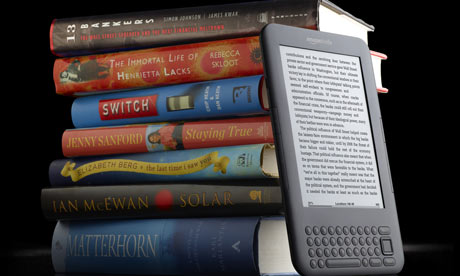
| Digital age of publishing |
But
that’s just my opinion, would a generation that was purely exposed to digital
publications think differently about online content?
References
Brannon, Barbara A. (2007) ‘The Laser Printer
as an Agent of Change’ in Baron, Sabrina et al., (eds.) Agent of Change:
Print Culture Studies after Elizabeth L. Eisenstein Amherst: University of Massachusetts
Press: 353-364
Lehrer, Jonah (2010) ‘The Future of Reading’, Wired, September 8, <http://www.wired.com/wiredscience/2010/09/the-future-of-reading-2>
Haile, Tony (2014) ‘What you think you know about the web is
wrong’, Time.com, March 9, <http://time.com/12933/what-you-think-you-know-about-the-web-is-wrong/>
Image:
http://static.guim.co.uk/sys-images/Guardian/Pix/pictures/2012/4/23/1335175243042/publishing-005.jpg


0 comments:
Post a Comment